Scenario modeling and forecasting for marketers
A tool for more effective marketing budget management
A tool for more effective marketing budget management
MARFOR answers a different question. Not how much you spent, but what happens if you split the budget another way — on your own data, with a real range instead of one flattering number.

Move a channel's budget and watch where revenue goes. Not in a straight line: the model knows where a channel saturates, and where the second half of the money returns half as much as the first.
Set the amount and the constraints, and the optimizer spreads it across channels to push the target as high as it will go — accounting for seasonality, saturation and your hard KPIs. Three strategies, from cautious to aggressive.

Every forecast comes with a P10–P90 interval. You see not just what you expect, but what you are risking: where the spread is tight, and where it is a gamble.
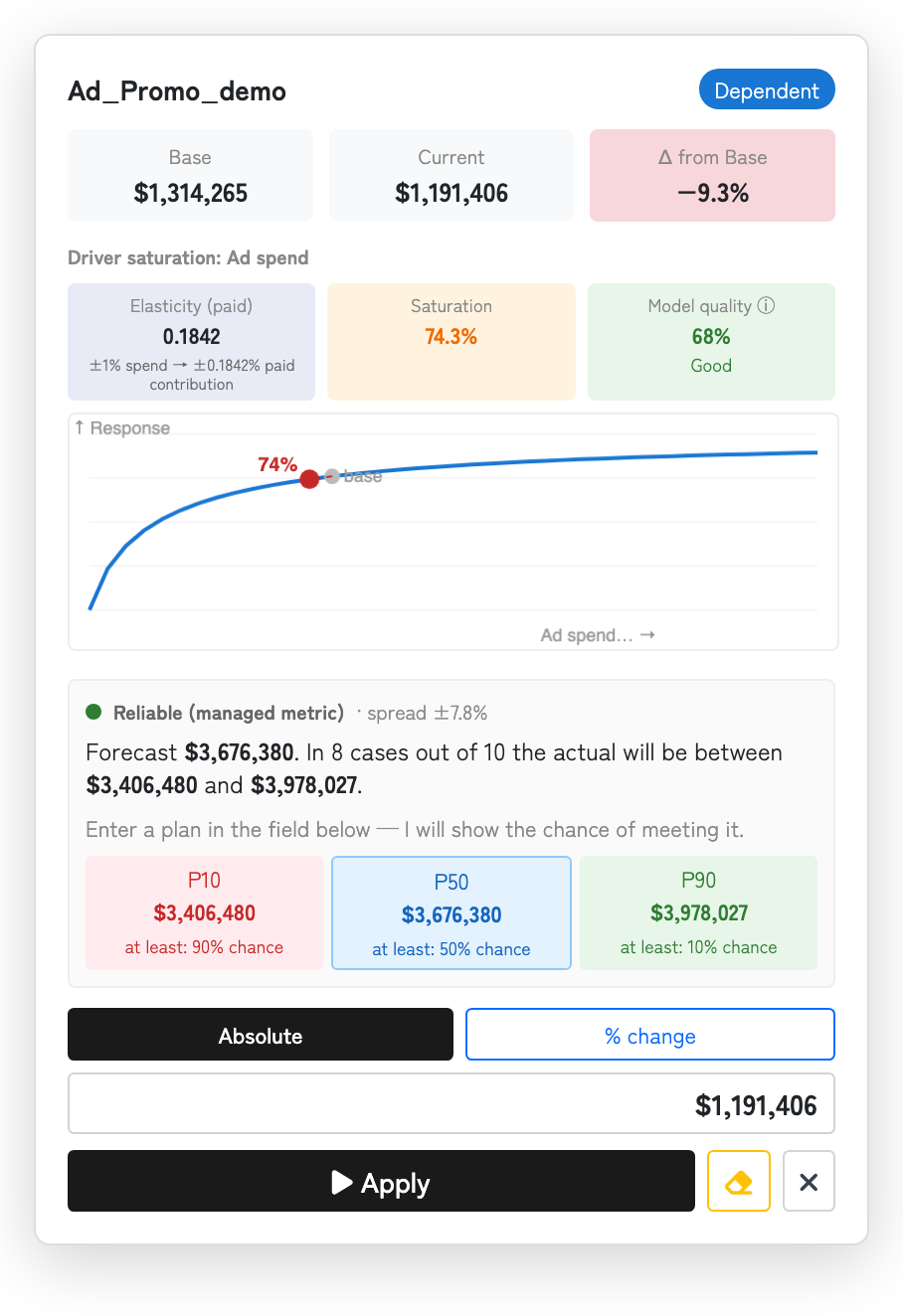
Screenshots show a demo project, Consumer Electronics, built on synthetic data.
With access to the same numbers and powerful AI, your team can make smarter decisions — together and faster.
Go from data to insights — fast. Build quick, reliable marketing reports that make sense.
Get a customizable data model. Rely on always-on, fully managed data connectors.
Scale your data offering. Strengthen agency-client relationships with reliable data and reports.
Start for free — grow with us. Teams and companies get personal support and dedicated capacity.
Marketing Mix Modeling is a statistical model that uses your spend and sales history to estimate how much each marketing channel contributes to revenue or orders. Unlike pixel-based attribution, MMM needs no cookies or user IDs: it links budget to outcome directly and accounts for seasonality, organic demand and promotions.
Last-click attribution credits the order to the channel of the last visit and misses display, offline and delayed effects. MMM estimates the lift a channel adds on top of what would have happened without it, accounting for carry-over (adstock) and channel saturation.
You set the total budget and per-channel constraints, and the optimizer allocates it to maximize your target metric. The model knows where a channel saturates and each extra dollar returns less, so it shifts money to where the return is higher. Any allocation can be tested in a what-if scenario before launch.
Spend by channel and a target metric (revenue, orders, leads) by day or week, uploaded as a file or pulled from connected sources. The longer the history, the more accurate the model; at least a year is recommended so it can learn seasonality.
The MARFOR core is a Bayesian model built on the open-source PyMC library: Hill saturation curves, adstock, and a hierarchy across slices (regions, categories). Every forecast comes with a P10–P90 interval, so you see not only the expected result but also the risk. Data is processed in ClickHouse, so tens of millions of rows are not a problem.
Yes. MARFOR connects to Claude via MCP: the assistant reads your scenarios, prepares budget changes with a dry run and builds dashboards. MARFOR also has a built-in AI assistant.
Join data-driven marketers already using MARFOR to plan their budgets.